

During the 2025 season, no team used “13” personnel (1 RB, 3 TE’s) more often or more effectively than Sean McVay and the Rams offense.
The benefit of the personnel grouping is that it generally forces the defense to match up with base personnel (3 linebackers). That’s a big deal because in today’s NFL, most defenses rely on nickel (5 DB’s) in order to keep up with the speed and lighter personnel packages that offenses normally deploy.
That means they generally use just 2 linebackers or fewer the majority of the time, and rosters are built accordingly. The 3rd linebacker on the roster is often a non-starting-caliber player or run specialist who only comes in on early downs and short-yardage situations.
Get a Founding Member subscription to access our Playbook
and have 90 breakdowns like this at your fingertips:
And this means an offense that can throw out of 13 personnel can exploit the weakest pass defenders on the field.
That was something the Rams were able to do all season. But in Week 10 in particular, they took advantage of a 49ers defense that had lost its best linebacker for the year (Fred Warner) and had a depth chart that was extremely thin at the position as a result.
San Francisco was forced to play with 3 linebackers on the field for much of the afternoon, and that included their 3rd and 4th linebackers on the depth chart to start the season (#48 Tatum Bethune #57 and Luke Gifford #57).
The Rams attacked those backers through the air with play-action, which they called on a staggering 51.4% of all dropbacks. Unsurprisingly, they had a ton of success.
Just check out the below play as an example. First, notice the 13 personnel and the 49ers matching up in base (3 LB’s):
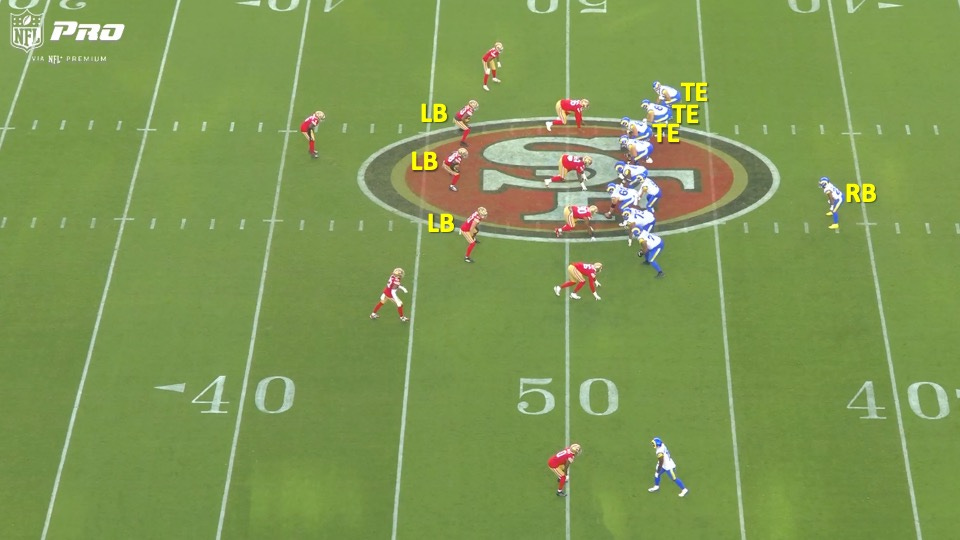
L.A. motioned tight end Terrance Ferguson across the formation right before the snap and had a post-wheel called: